
Ask ten people what the middle class is, and you’ll probably hear ten different answers. However, the numbers behind it are rather clear, although they aren’t exactly the same in Canada and the United States.
Things like housing and tuition affect how everyday life looks for the middle class. It’s nowhere near as simple as some people think. Let’s find out exactly how things look for people in either country.
How would you define the middle class in your own words?
Defining the middle class

The Pew Research Center defines the middle class in America as the households that earn between two-thirds and double the national median, adjusted for size. The median household income in the United States was $83,730 in 2024, or approximately CAD$114,153.
Statistics Canada said the median market income in 2023 was CAD$68,700. There’s clearly quite a big difference in earnings across both countries.
Home prices in major cities

One of the major areas that the middle class gets tested is real estate in major cities, with the Toronto Regional Real Estate Board reporting the average selling price in 2025 was $1,067,968. The market in Vancouver is similarly in the seven-figure territory.
However, in the United States, the median sale prices in cities like Dallas are in the mid-$300,000s, or CAD$408,843, while homes in Phoenix are regularly under $500,000. That’s around CAD$681,405. As such, many Canadian metropolitan areas rank as some of the least affordable on the continent.
Rent pressure

Many housing agencies follow a basic rule stating that spending more than 30% of your income on your home is an unaffordable way of living. Sadly, it’s all too common in big cities in both countries.
Toronto and Vancouver frequently rank among some of the highest rental markets in Canada, although the story isn’t much better in America.
Data from Zillow shows that rent prices can swing quite widely in many American cities, depending on the metro area. There’s no denying that the urban middle class is squeezed on either side of the border.
But the truth is that supply constraints are generally much tighter in Canada’s larger cities.
Healthcare costs

Where the middle class really splits is in terms of healthcare.
You probably already know that Canada has universal public coverage, and the average per-person health spending is in the high-$8,000 CAD range, according to the Canadian Institute for Health Information’s reports.
Those figures are nowhere near as high as those in America, as you probably expect.
The Centers for Medicare and Medicaid Services reported that the average American health spending was around $15,474 in 2024, or around CAD$21,085. In fact, research from the American Journal of Public Health has found that medical bills are the cause of many Americans filing for bankruptcy.
They have to deal with higher cost variability while we Canadians face fewer catastrophic bills.
Taxes and take-home pay

The OECD’s Taxing Wages 2025 data shows something rather interesting for both countries. In Canada, the average tax rate for a single worker is 25.5%, but in America, it’s 24.4%, which isn’t a huge gap. But the real difference comes from how people structure their expenses afterwards.
Americans have employer health insurance premiums and private add-ons that tend to come outside of their tax totals. But in Canada, a lot more of our services are part of public funding streams, meaning that higher take-home pay doesn’t always equate to lower total costs for Americans.
University tuition

Data from Statistics Canada shows that average undergraduate tuition was around $7,734 for the 2025-2026 school year, and that’s nothing compared to the American figures. The average cost of tuition and fees at private non-profit four-year U.S. institutions was around $45,000 for 2025-2026, or CAD$61,346.
Of course, the price of going to a public university is a little different, but the overall contrast is quite clear. There is a chance of getting broader high-end earnings in America once you finish university. Yet studying in Canada often means that you’ll start off with a lower amount of debt than in the United States.
Childcare costs

Sadly, childcare feels a lot like another rent payment for many parents. Child Care Aware’s 2024 affordability analysis found that infant center-based care takes up quite a sizeable amount of median family income in many American states. It’s around 12 to 25% of household income.
But in Canada, recent federal legislation has reduced the costs of childcare, and the average full-time home-based childcare costs around $534 per month in 2025. The same care can be as much as CAD$21,014 per year in the United States, or around $1,751 per month. Clearly, childcare costs can be tight in both countries.
Income inequality vs. upside

Researchers tend to use something called the Gini Index to measure how income is spread across a country, with a higher number indicating more inequality. Canada received a score of 31.1, and America received a score of 41.8.
The U.S. also has higher top-end salaries in many different sectors due to it having a larger economy, but Canada’s wage distribution is generally narrower. It appears that America offers greater earning upsides while Canada has tighter income gaps.
Safety nets

Several Canadian federal programs work as safety nets for residents, including universal healthcare and the Canada Child Benefit, which includes maximum annual amounts decided by the CRA. There’s also the Canada Pension Plan (CPP) and Old Age Security (OAS).
Over in America, the federal government administers Social Security nationally. But a lot of other supports depend on what state you’re in or your employer’s benefits. The support systems in each country vary in structure, rather than in terms of generosity.
Market vs. public baseline retirement

American retirement savings tend to go through employer-sponsored plans like 401(k)s and IRAs. There’s also Social Security, and that gives people a baseline benefit, based on their lifetime earnings. But things work a little differently in Canada.
We have an overall broader income floor, thanks to things like CPP and OAS. The payment formulas and contribution rules for these are set federally. As such, retirement in America depends more on how the market performs than in Canada.
Geography changes everything
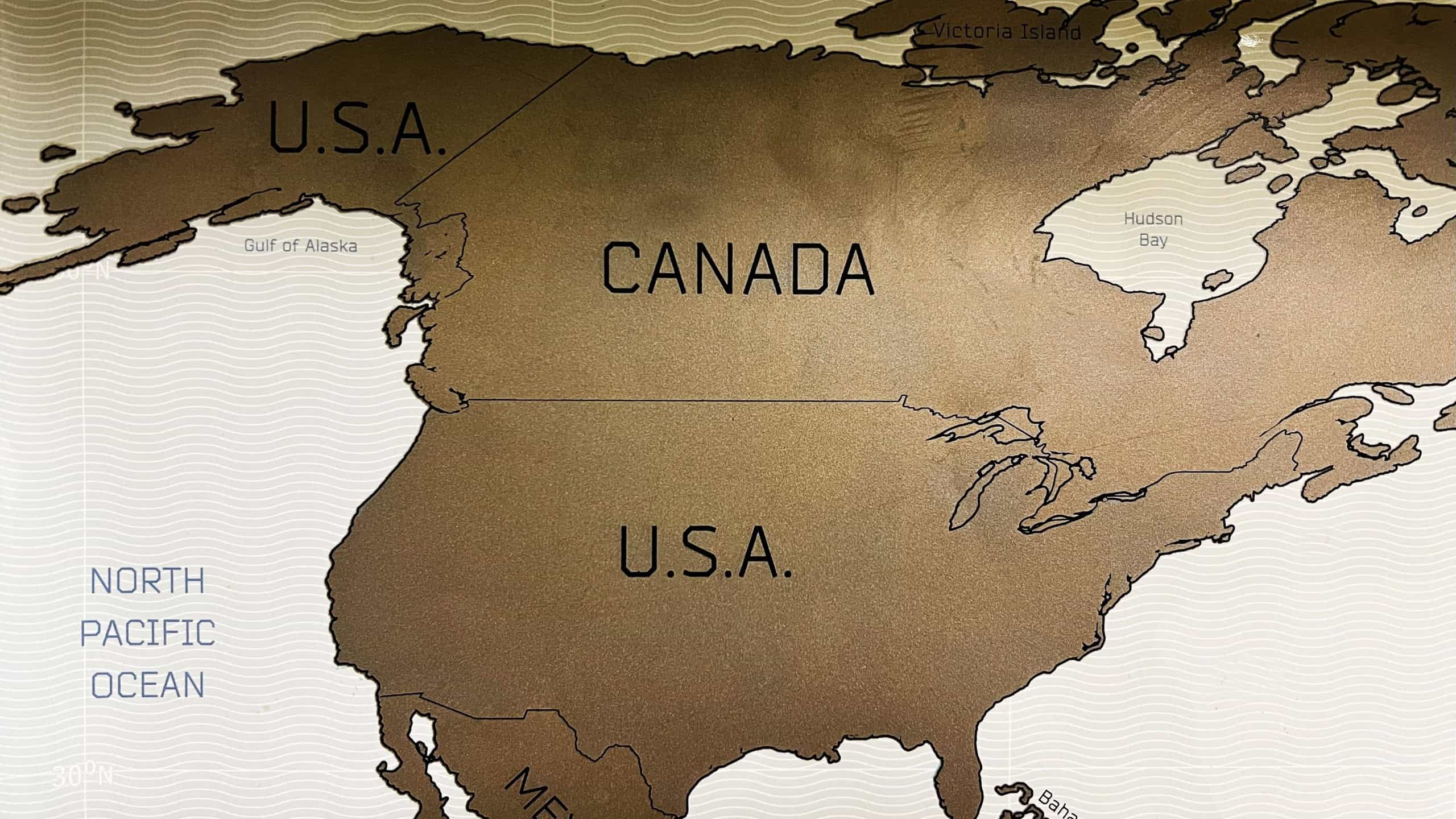
We also can’t forget about the effect of geography. For example, the median home sale price in San Francisco is around $1.3 million, according to Redfin, and the average in Toronto is seven figures. But then try comparing Calgary’s benchmark prices to Houston, and you see much lower ranges.
Clearly, the range inside each country can be quite vast, and the city you live in can influence your monthly costs more so than the passport that you hold.
Stability or opportunity?

So what’s the overall consensus? Generally speaking, America has higher per-person healthcare spending and a higher Gini Index than Canada does. But we have broader public program coverage and lower measured inequality.
Both of these countries define the middle class through income bands that depend on national medians. Factors like taxes, healthcare, education, and retirement, among others, affect how a middle-class income works out in daily life. How much uncertainty you’re willing to live with is as much of a deciding factor as income.
Sources: Please see here for a complete listing of all sources that were consulted in the preparation of this article.
10 signs of a lower middle class childhood

Growing up lower middle class meant learning to budget and making do with little in life.